Celebrating the Launch of Mauri Magazine
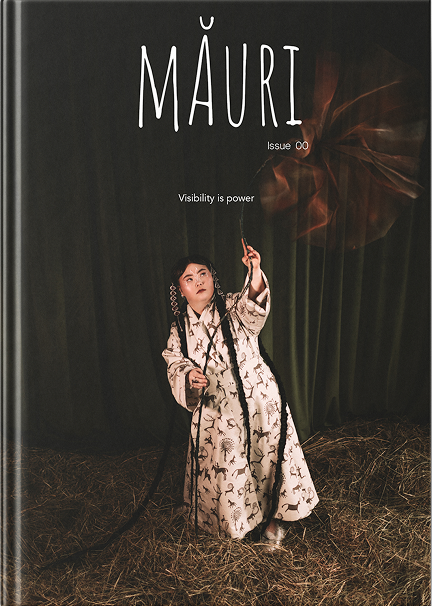
Cover of Mauri Magazine. Text reads: Mauri Issue 00 Visibility is power. Cover photo is of a person wearing a white printed tunic, standing in hay, floor-length braids, holding a piece of artwork (large flower).
Mauri Magazine is a new magazine that celebrates inclusion, representation, and diverse creative voices. They’re excited to announce the launch of their first issue coming out in September. The magazine was created for and with the disability and neurodivergent communities. The aim of the magazine is to explore accessibility and self-expression through fashion, art, and storytelling.
Founder, Iulianna Shilova, is an autistic woman, fashion stylist, creative director, and disability advocate. She and her team shared some of the motivation and upcoming work with Diversability. Here’s what they shared with us.
Diversability: What does the launch of Mauri Magazine mean to you?
Mauri Magazine: The launch of Mauri means something slightly different to each of us because we all came to the project through our own experiences.
For some of us, it represents a very personal journey towards understanding and accepting our own disability or neurodivergence. Learning to speak openly about your body, accepting that you may need a mobility aid, or simply becoming comfortable with the fact that your experience of the world is different can take time. For others, Mauri grew from years spent close to the disabled community and from seeing how much talent, personality and creativity existed there without being given the same space elsewhere. In that sense, launching Mauri feels like taking something that was once deeply personal and turning it outward. We have spent a great deal of time learning who we are. Now we have the opportunity to use that understanding to create something for other people.
It also means seeing an idea that we have invested an enormous amount of ourselves into finally entering the world. Mauri has demanded our time, patience and a fair amount of stubbornness. So September is not simply the publication of our first issue. It is the moment something that has belonged to us for so long begins to belong to its readers as well.
Diversability: What do you hope will be the impact of your magazine on the disabled community and disability culture?
Mauri: More than anything, we want someone with a disability or neurodivergence to open Mauri and think, “There is a place for me here.” But we also want them to feel excited. We want people to look forward to discovering the next photographer, model, stylist, journalist, designer or artist; to find someone whose work they love, follow them, contact them, collaborate with them, or perhaps see a possibility for themselves that they had never considered before.
One of the things creating Mauri has taught us is just how extraordinarily diverse our own community is. Even as a disabled and neurodivergent team, we are constantly learning from people whose experiences are completely different from our own. Bringing so many of those voices and creative disciplines together in one place gives us an opportunity not only to represent the community, but to help people within it discover one another.
At the same time, Mauri isn't a magazine we want only disabled and neurodivergent people to read. We want someone with no personal experience of disability to pick it up simply because they are curious. We want them to enter this world through art and leave thinking differently about accessibility and inclusion.
What we're lacking as a community isn't talent. It's a stage. There are creatives who deserve the opportunity to show what they can do. Ultimately we want Mauri to be one of those stages. We aim to create a connection between our community and people outside of it — one built on collaboration rather than observation.
Diversability: What inspired the creation of Mauri Magazine?
Mauri: The idea behind Mauri began six years ago, when I started volunteering with people with disabilities. Over time, the community became incredibly close to me, and I found myself asking a simple question: why were people who had brought so much into my life still so underrepresented in the culture we all consume?
I could open a fashion magazine and see hundreds of different stories, aesthetics and identities, yet rarely see disabled people — and even more rarely see them given the opportunity to tell their own stories. Fashion is both my field of study and my professional practice. Through my work as a stylist and my education in fashion, I have come to understand it not simply as clothing, but as a language and a form of communication. It’s a way of expressing our identity, our relationship with our bodies and how we want to present ourselves to the world.
When I was diagnosed with autism myself, many things I had previously understood only intuitively became much clearer. Eventually, these different parts of my life came together: my relationship with the disabled community, my own experience of neurodivergence, my work and education in fashion, and the feeling that something was fundamentally missing from the industry.
That is where the idea for Mauri began.
Diversability: What makes Mauri Magazine different from other magazines?
Mauri: We don’t simply want to add disabled and neurodivergent people to an existing picture. We want to change the picture itself. Mauri is created from within the community. Our core team is made up of disabled and neurodivergent women, several of whom study or work professionally in fashion. That lived experience inevitably shapes the questions we ask and the way we approach representation.
First and foremost, Mauri is a fashion magazine. We approach disability through fashion rather than treating it primarily as something medical or educational. Our contributors don’t need to explain their disability in order to deserve space in our pages. Creative merit, however, is fundamental to us. We deliberately seek out exceptional talent within this community. A disabled photographer is there because they can create an extraordinary editorial. A disabled model is there because they are an extraordinary model.
One of the things that surprised us most while creating Issue 00 was just how much exceptional talent was already there to be found. The fashion industry sometimes treats inclusion as though it requires laborious breakthroughs. Our experience has made us question that. The talent is not difficult to find, but it has to be looked for, given space and taken seriously.
We also have no interest in presenting only the versions of disability that are easiest or most familiar for mainstream fashion to embrace. We want to broaden ideas of beauty, bodies, movement and desirability, while giving our creatives room to experiment — to be beautiful, strange, provocative, playful, sexy or unexpected. Disability doesn’t have to dictate the creative concept, it can exist within it.
Diversability: What was your most memorable moment during the journey to launching the magazine?
Mauri: Without question, seeing the first physical copy. For such a long time, Mauri existed as separate pieces. We had all seen different parts of the magazine throughout the process, but seeing the finished physical copy was completely different. It was enormous, and suddenly we could comprehend the scale of what we had created. Stories we had approached, pieces we had written, editorials we had worked on and people we had spent months speaking with were all there, together, in one object. That was the moment Mauri stopped feeling hypothetical and became real. We were so emotional about it.
Some of our most memorable moments have also come from the way the community welcomed us. We haven’t officially launched yet, so there are hopefully many more ahead of us, but the response we’ve already received has been incredible. People have trusted us with their work, offered advice and constructive criticism, introduced us to others and supported the project simply because they believe it should exist.
We are also a very young team, so there is a genuine sense of excitement around the opportunities beginning to open up in front of us. Every new connection still feels exciting, and we hope we never completely lose that feeling. But what has mattered most throughout the process is that we continue to show up for one another. Building an independent magazine inevitably comes with difficult days — limited funding, exhaustion, uncertainty, or ideas we don’t yet have the resources to realise. When one of us cannot carry something, someone else does.
Diversability: What’s next for Mauri Magazine?
Mauri: First, our launch. Issue 00 will be released this September in both print and digital formats. The magazine will be published twice a year, but we don’t want the conversation to exist only around the release of each issue.
We are developing our online presence into a continuous editorial space where we can invite people to participate in conversations beyond the pages of the magazine. We are also interested in exploring other formats like audio.
At the same time, we aim to expand our network across the wider fashion industry and become a hub where talent can be discovered and, ultimately, professional opportunities can emerge. As we grow, we also hope to become a trusted voice for brands and institutions that want to approach disability, accessibility and inclusion with greater knowledge and intention. We want Mauri to become a brand in its own right, with a distinct editorial identity, taste and reputation — one that carries a recognisable point of view and a certain standard.
Greater financial stability will naturally allow us to explore projects that currently sit beyond the practical limits of a young independent magazine. Perhaps that makes us ambitious, but we also believe there is enormous value in not deciding too early what we are allowed to become.
We are also always interested in discovering new voices and creative work. While submissions for Issue 00 are now closed, people are welcome to submit their work for consideration for future issues and our other editorial platforms.
A special thank to the Mauri Magazine team for this heart-felt interview. To pre-order Issue 00 and to learn more about the team, visit their website. They are also active on Instagram, TikTok, and LinkedIn, where we share editorials, interviews, behind-the-scenes moments and updates as we approach our official launch.