Author Alan Carrigan Introduces Debut Novel, Then We’ll Be Happy
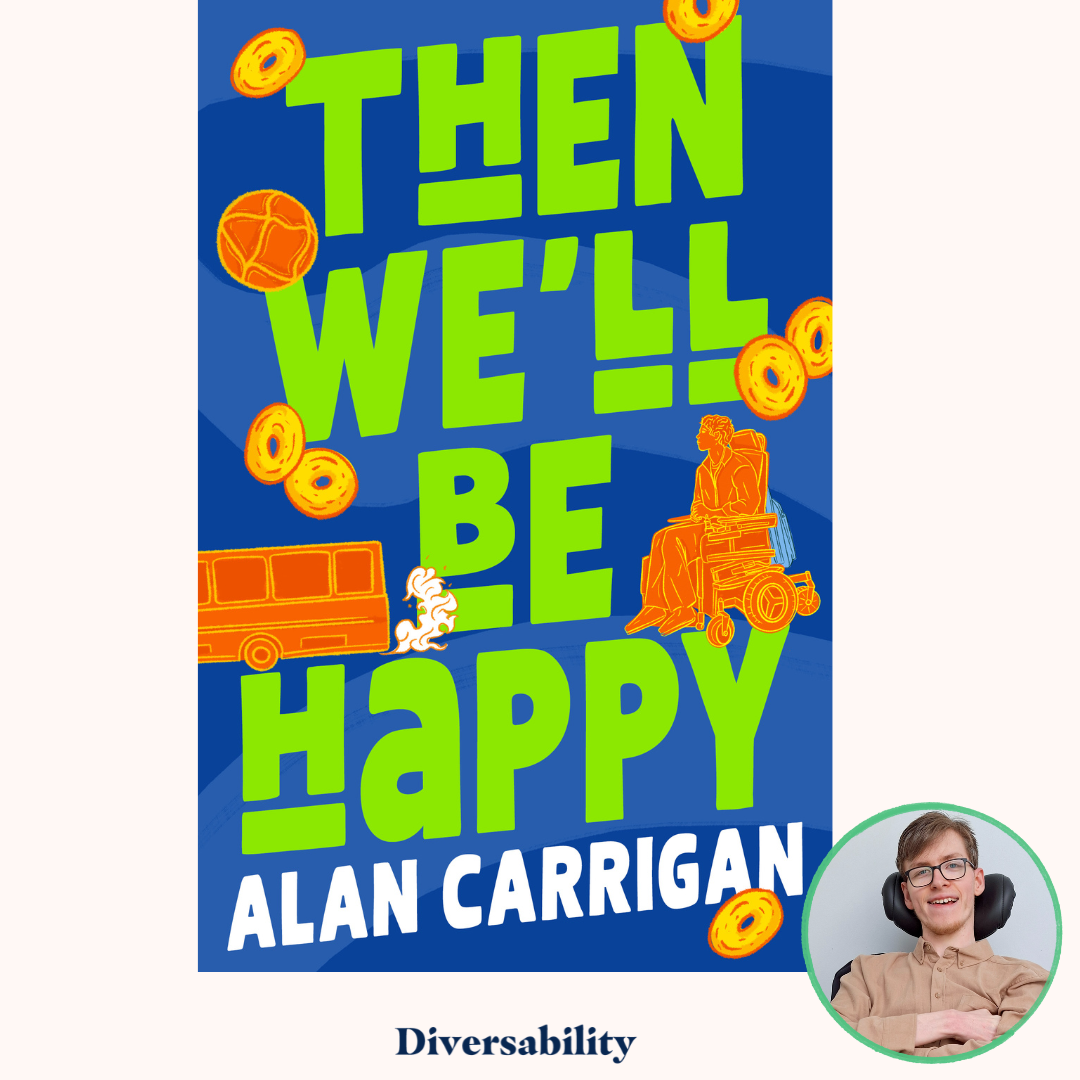
Book cover of Then We’ll Be Happy by Alan Carrigan with a small headshot of Alan in green-rimmed circle at the bottom right. The book cover is shades of blue with orange illustrations of donuts, a bus, a ball, and someone in a motor-wheelchair. The text Then We’ll Be Happy is in bold lime green text and Alan Carrigan is in white text.
Author Alan Carrigan is thrilled to announce his debut novel, Then We’ll Be Happy (Chicken House Publishing). This young adult novel follows Sam, a 17-year-old with cerebral palsy, who wants to gain some control over his life. According to Chicken House Publishing, this novel is “an authentic, witty and nuanced story with a powerful, universal message, about unlikely friendships and the realities of living with disability.”
Alan, who has cerebral palsy and uses a wheelchair, is “keen to use his writing to increase positive representation of physical disability and help to show young people that they must not let others' perceptions of them hold them back.” In our interview with Alan, we learn more about The We’ll Be Happy, his writing process, and why inclusive storytelling is so vital.
Diversability: What does it feel like to live by your quote “"Don't let the fear of perception hold you back from doing the things that could change your life"?
Alan Carrigan: What you’re referring to is from a TEDx Talk I delivered when I was 21. Back then, I honestly thought I was fearless, but I am still learning each day what it truly means to live by this quote. Having said that, I spent the last three, almost 4 years writing a novel having no prior experience, so for me now, yes, I think honestly I do have some work to do on my own self-perception and idea of what is possible for me. But I would consider myself a very ambitious person, so while I still have off days, I know that there are lots of things that I want to achieve in my life that others can help with, but I have to be the driving force. It’s OK to wallow sometimes, but also, if you want to get things done, especially creative things, sometimes in my experience, you have to ignore your inner critic and see where instincts take you.
Diversability: Why was it important for you to write Then We’ll Be Happy geared towards Young Adult readers?
Alan: Growing up as the only wheelchair user in a mainstream school, the disability representation that I saw at the time fell into two categories, over inspirational, or really depressed characters, which non-disabled characters would have to cure in some ways. When I set out to write my novel, I wanted to write something that sits in between these two narratives. Something that my younger self would love to read, and in turn something that I hope others can connect with too!
Diversability: How much of Sam’s story is based on your lived experience? Any specific examples you’d like to share?
Alan: Sam’s physicality is certainly based on my own, having said that, I have adjusted it in places to flow with the story. Plot wise, though, I would say that his experience with inaccessibility within the school environment was the opposite of my own. In fact, my transition year experience was quite formative for me and the idea for the story came from imagining what would happen if somebody did not have an accessible bus. I have also had the great fortune of interviewing many disabled people over the years. Unlike Sam, I don’t think I’ve found my people yet. I know it’s weird to say because I wrote him, but I think he is a lot more emotionally intelligent than I was when I was 17. So, yes, while I think there are lots of similarities between Sam and me, I think he has also taught me a lot.
Diversability: What was your writing process like? As someone with cerebral palsy, did you use any assistive technology to help write your novel (like dictation, Eyegaze, head tracking, etc.)?
Alan: It was a lot of trial and error. Due to the way spasticity affects me. If I were to type every single word, I would need to use one finger, which, apart from the obvious time it would add to the already lengthy publishing process, would also mean my motivation would drain much more quickly. So while I have tried most of the popular dictation software out there, I eventually determined that the built-in dictation of Mac OS works best for me. Dictation rarely agrees with the tone of my voice, so I still have to correct the chapters by hand, but it definitely speeds up the process.
Diversability: What do you hope readers get out of reading your novel?
Alan: I don’t think that’s for me to say. I think what readers get out of the novel is what they personally get out of the novel. I have tried to pack it full of authentic, witty characters. And I hope people find ways to enjoy them.
Diversability: What’s next for you?
Alan: Nothing’s officially under contract yet, but I do thoroughly enjoy writing, so I’ve been chipping away at a few ideas. I think this novel will be my most in-your-face about disability, but all of my ideas, whether fantastical or grounded in reality, will hopefully include more disability representation. I don’t know what form that will take yet, but watch this space.
Thank you, Alan, for this moment to learn more about your writing. THEN WE’LL BE HAPPY by Alan Carrigan is out now in paperback (£8.99, Chicken House).