Diversability Amplified Podcast: Moving Disability Media Forward with Lawrence Carter-Long [S2:E16]
Diversability Amplified Podcast: Moving Disability Media Forward with Lawrence Carter-Long [S2:E16]
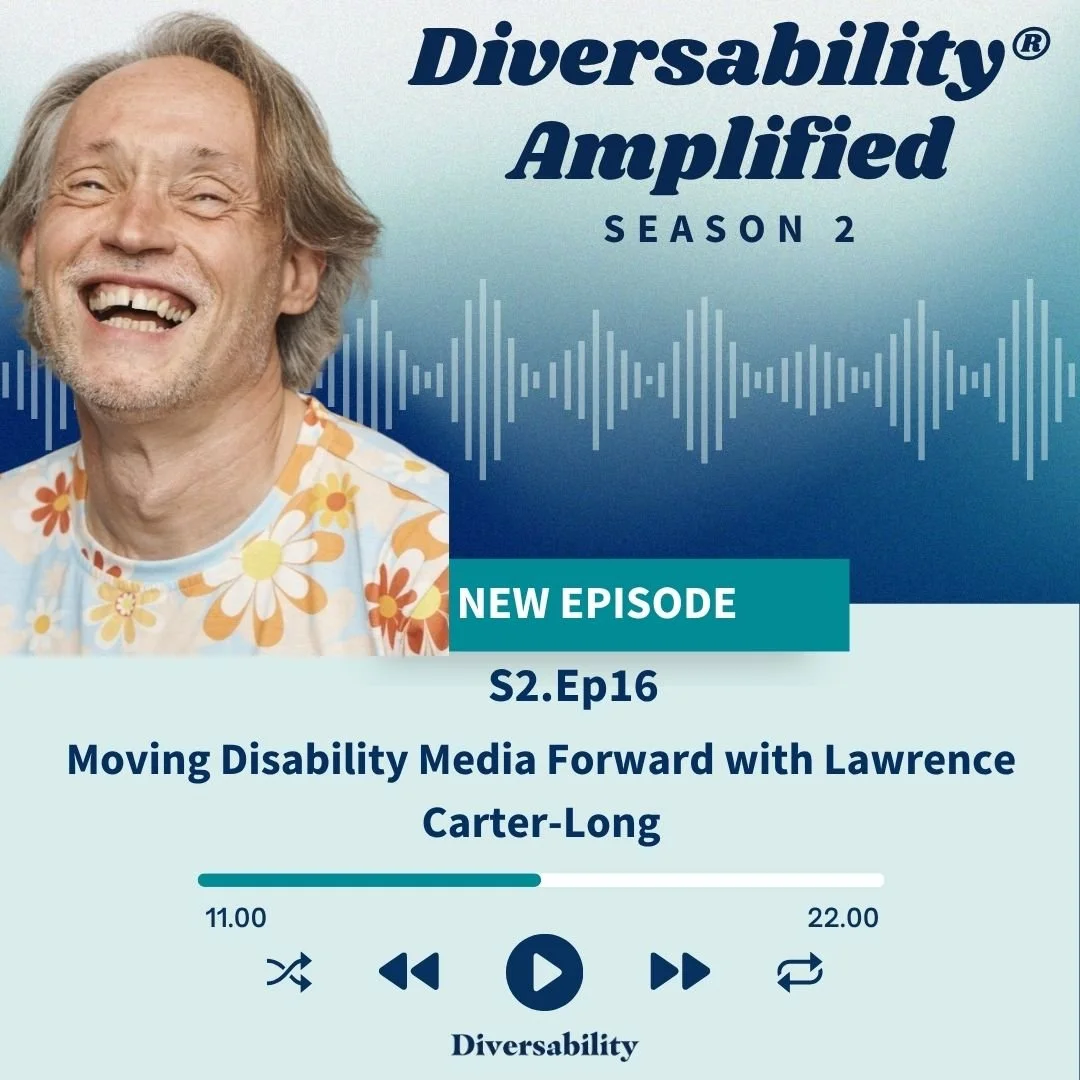
A gradient blue background with airwaves takes up the top half. Dark blue text "Diversability Season 2". To the left is a cutout photo of Lawrence. Centered is a blue box with text "New Episode". On the bottom half is a light blue background with audio control mockup. Centered text "S2:E16 Diversability Amplified Podcast: Moving Disability Media Forward with Lawrence Carter-Long."
In today’s episode, host Erin Tatum is joined by Lawrence Carter-Long, Director of Engagement at Reelabilities. Lawrence answers the question, “How do we move disability in media beyond metaphor, inspiration, and approximation, and what does it look like when festivals like ReelAbilities actually program and present alternatives?” Their conversation leads them to examine whose story gets told, who gets to tell them, what kinds of disability narratives get rewarded, and how ReelAbilities is working to expand the field in comprehensive ways that include programming, presenting, accessibility, community, and industry engagement.
Show Notes
Advancing Disability Representation in Media
Authentic Disability Representation in Film
Disability Representation in Media Storytelling
Disability Film Selection Challenges
Disability Representation in Cinema Evolution
Disabled Representation in Media Discussion
Disability Representation in Storytelling
Diverse Disability Experience Narratives
Reelabilities Festival Planning Discussion
Meeting summary
Quick recap
This podcast episode featured a discussion between Erin and Lawrence Carter-Long about bringing disability forward in media, focusing on the work of Reelabilities film festival. Lawrence explained how the festival, now in its 18th year, aims to move beyond traditional ableist tropes by showcasing diverse disability narratives across various genres and perspectives. They discussed the importance of authentic representation, including both central and peripheral disability storylines, and highlighted the growing quality and diversity of independent disability-focused films. Lawrence shared details about the upcoming festival, including over 30 films across 20 venues with accessible screenings, and emphasized the festival's role in fostering community conversations and expanding people's understanding of disability beyond stereotypes.
Advancing Disability Representation in Media
Erin and Lawrence discussed moving disability forward in media, focusing on authentic representation beyond just countering ableist tropes. Lawrence emphasized the importance of examining both what is being represented and who is doing the representing, highlighting the need for meaningful agency and leadership in decision-making roles such as writers, producers, and directors. He also stressed the significance of exploring stories that reflect the complexities of disabled experiences rather than limiting them to simple narratives of tragedy or heroism.
Authentic Disability Representation in Film
Lawrence and Erin discussed the importance of representing disability authentically in film, emphasizing the need to move beyond simple metaphors and showcase the complexity and messiness of lived experiences. Lawrence highlighted that despite disability representing around 28.7% of the US population, disabled characters on screen only account for 1-3% of roles, and called for more diverse representation across all film genres. The discussion focused on the festival's mission to highlight the nuance of disability beyond just a shortcut for industry storytelling.
Disability Representation in Media Storytelling
Erin and Lawrence discussed the representation of disabled people in media and storytelling. They agreed that while disability can be central to a story, it should not be the sole focus, but rather one aspect of a character's identity woven into the overall narrative. Lawrence shared his perspective that disability has shaped his ability to adapt and innovate in a world not designed for people with disabilities, emphasizing the valuable skills developed through navigating such challenges.
Disability Film Selection Challenges
Lawrence and Erin discussed the importance of spaces like Reelabilities for facilitating conversations about disability and marginalized identities through film screenings and discussions. Lawrence highlighted the growing quality and diversity of submissions from independent filmmakers worldwide, making it increasingly challenging for the selection committee to choose which films to screen. He noted that while major studios often produce stereotypical content, independent filmmakers are bringing more nuanced perspectives to the forefront, leading to a richer array of disability experiences represented in films.
Disability Representation in Cinema Evolution
Lawrence discussed the evolution of disability representation in cinema over the past 20 years, highlighting how Reelabilities has contributed to expanding this representation beyond traditional tragic or heroic narratives. He explained that the festival has helped shift perceptions of disability from a narrow view to a more diverse and nuanced understanding, showing disability as a complex aspect of culture, community, and identity rather than just a diagnosis. Lawrence emphasized the impact of seeing authentic disability representation on audiences, noting how it can be life-changing for viewers who see themselves reflected on screen for the first time.
Disabled Representation in Media Discussion
Erin and Lawrence discussed the importance of disabled representation in media and how it expands their sense of community. Erin shared that seeing disabled people on screen helps reduce isolation and reminds viewers of their community's presence. Lawrence explained how his involvement in film work has broadened his community connections, revealing commonalities with people from various disabilities and backgrounds. Both speakers emphasized the positive impact of independent filmmaking in showcasing disabled perspectives and experiences.
Disability Representation in Storytelling
Erin and Lawrence discussed the importance of disability representation and authorship in storytelling, emphasizing that disability experiences are diverse and universal. Lawrence highlighted the significance of who tells these stories and encourages audiences to engage with challenging content by reflecting on their reactions and discussing with others. Erin shared a personal example illustrating how disability can affect different family members in varying ways, reinforcing the universal nature of disability experiences.
Diverse Disability Experience Narratives
Lawrence discussed how disabilities often develop later in life, affecting approximately 80% of people who have them. He shared his personal experience of how his relationship with cerebral palsy has evolved over time, including the addition of other conditions like depression and diabetes acquired during COVID-19. Lawrence emphasized the importance of telling more nuanced stories about disability, moving away from traditional tragic or heroic narratives to showcase the diverse experiences beyond the margins.
Reelabilities Festival Planning Discussion
Erin and Lawrence discussed personal reflections on disability perspectives and the upcoming Reelabilities festival. Lawrence shared insights about his journey toward self-acceptance and embracing disability culture, emphasizing the importance of community and authentic representation. He outlined several highlights of this year's festival, including over 30 films across 20+ venues, with all screenings offering audio description and open captioning. The festival will feature films like "Lone Wolves," "Victor," and "We Might Regret This," along with discussions aimed at building community and fostering understanding around disability experiences.
YouTube: https://youtu.be/XItOMP2vRUQ
Spotify: https://creators.spotify.com/pod/profile/diversability/episodes/S2E16-Moving-Disability-Media-Forward-with-Lawrence-Carter-Long-e3i2ih6
Transcript
00:02:49.829 --> 00:03:00.159
Amplified podcast. My name is Erin Tatum and I am the Diversity Leadership Collective Director. My pronouns are she and her.
00:02:59.887 --> 00:03:10.887
And I'm a white woman with. A blue dress with pink flowers. And today, I'm here with Lawrence Carter Long.
00:03:10.928 --> 00:03:26.928
Hi, Aaron. Lawrence here. Yes, as you said, I'm a skinny white guy, middle-aged, blondish, increasingly silver hair, wearing a green and orange floral sort of summer sweater.
00:03:27.146 --> 00:03:29.146
And it's my pleasure to be here with you.
00:03:28.965 --> 00:03:33.965
Thank you, I didn't even realize we're matching florals! We're coordinating!
00:03:33.965 --> 00:03:39.199
Yes, we are. We're feeling the season!
00:03:39.199 --> 00:03:43.368
Exactly, spring has sprung, my friend. And I know because you're.
00:03:43.369 --> 00:03:44.262
Yes.
00:03:43.903 --> 00:03:56.903
You work so closely with. real abilities in honor of… real ability is we wanted today. I know we want to focus on moving disability forward in media.
00:03:56.724 --> 00:04:00.724
Well, wonderful. It's one of my favorite subjects. Please, let's do!
00:04:00.967 --> 00:04:28.967
Yeah, and I know a lot of. Sometimes people think of disability representation in media as basically the opposite of ableism or countering ableist tropes, but… I also really feel like it has its own qualities and its own characteristics that lend itself to real authenticity beyond just not inspiration porn.
00:04:29.304 --> 00:04:46.304
Yes, absolutely. I think it's it's easy to throw around words like representation, but I think to… in order for it to be meaningful, we have to scratch beneath the surface and see what do we mean in terms of, one, what is being represented, and two.
00:04:46.516 --> 00:04:55.516
Who exactly is representing? And so, with those things in mind, I, you know, I think with RealAbility specifically.
00:04:55.518 --> 00:05:28.456
Film is the front door, right? It's sort of the entry point to everything that we do, but if you go through that door, um, you're gonna find community and conversation, and culture, right? That… You throw them together, and it's a recipe for real change, for concrete change. And I think it's, um, a unique place where artistry and access meet, and where disability is treated not as some kind of sideline, something special over here in the corner.
00:05:28.073 --> 00:05:43.073
But as the main event. And, uh, so it gets to thinking about not only the stories we tell, very important, I think that's core, but also who gets to tell them.
00:05:42.863 --> 00:05:52.863
Uh, why they're telling those stories, and how those stories are being told. So, it goes beyond, to my mind, you know, when we talk about things like representation.
00:05:52.974 --> 00:05:57.974
It tends to focus on what actors play which parts.
00:05:58.971 --> 00:06:14.971
But I'd go a little bit deeper, because I think we have to talk about agency, and we have to talk about who's in leadership positions, who gets to make the decisions about what gets made and how, and what focus that takes. And so that means.
00:06:15.723 --> 00:06:29.723
Writers, producers, directors, studio executives, right? People who are in the decision-making spaces so that we can go a little bit deeper and a little bit farther beyond.
00:06:29.984 --> 00:06:44.984
Sort of the polarities that we've been conditioned to accept, and that would be tragic, or heroic. Uh, most people that I know, disabled folks, live somewhere in the messy mibble. The messy middle is much more interesting.
00:06:48.931 --> 00:06:50.931
To explore.
00:06:50.932 --> 00:07:03.749
Because the middle represents nuance, which means the middle is, I feel like, the closest approximation to real life. By definition, lived experience is not just one thing.
00:07:07.898 --> 00:07:11.898
combination and an amalgamation of everything.
00:07:11.899 --> 00:07:38.868
Yes, exactly. And film, you know, if you're thinking about the the context of film in particular, that covers a lot of ground. You've got dramatic movies, you've got comedic movies, you've got… Documentaries, you've got narratives, you've got animated, you've got short films, right? There's a lot of ground that you can cover within that, and so what, you know, the thing that we really, um, are emphasizing with our festival, which is now in its 18th year.
00:07:38.698 --> 00:07:42.698
And our work is that disability has often been.
00:07:42.620 --> 00:08:00.620
A shortcut for the industry, um, a way for them to sign… to kind of, um, spotlight something, or highlight something, but without really getting down to the nitty-gritty details. And we're here to remind people that disability is so much more than a metaphor.
00:08:00.769 --> 00:08:07.769
It's, like you said, life, and that, and all the complexity, all the messiness that comes with it.
00:08:09.317 --> 00:08:21.317
Yeah, and I know as a disabled person myself, I can speak to the messiness for sure. I would say that's pretty common in the community, or at least with me on a microcosmic level.
00:08:21.270 --> 00:08:32.270
Yes, a messiness is where life is, right? And that's where you learn, that's where you grow, that's where you stretch, and I would also say, you know, if you look at.
00:08:32.011 --> 00:08:38.011
Let's just look at the statistics, the numbers we can verify, right? We know that.
00:08:38.077 --> 00:08:57.077
If we're just looking at disabled characters on screen. Tv, film, all of the above. The number of disabled characters that we tend to see on screen, not even played by disabled actors, mind you, just disabled characters in and of itself. That tends to fluctuate on any given year between 1% and 3% on a good.
00:08:57.036 --> 00:09:12.036
year. It's been that way for the last 10 years. Hasn't really changed. If we look at society, though, let's look specifically at the United States. The Centers for Disease Control and Prevention will tell you that the number of people that identify as disabled.
00:09:12.418 --> 00:09:26.418
Probably more who wouldn't even use the word, but the number of people who identify as disabled is around 28.7%. So we've got a lot close… we've got a lot of work to do before we're closer to reality.
00:09:26.419 --> 00:09:43.149
And so I think in terms of film, the real work has two major strands. One is, yes, being more reflective of reality. What are the lived experiences that people have? What are the lives that disabled people actually lead with all that nuance and all that messiness?
00:09:42.835 --> 00:09:58.835
And then I think, but not all film is a documentary. Uh, as I started to say before, you know, what about disabled people in space? What about romantic comedies? What about action movies? What about, you know, any genre that you can imagine?
00:09:58.651 --> 00:10:14.651
Why don't we have more disabled people there as well? So it's not only about being more reflective of reality, but also igniting imagination, more disability-themed musicals, for example, and trying to get a, uh.
00:10:14.915 --> 00:10:19.915
To plant those seeds for the kind of world that could and should be.
00:10:21.569 --> 00:10:36.569
And I think that's a good point to make as well. I feel as though within the industry, so much of disabled storylines are about being disabled or about disability in itself, but I feel.
00:10:38.274 --> 00:10:52.274
Real progress also looks like just letting disabled people exist in singularity without the entire plot being driven and shaped by diagnoses or appearances.
00:10:52.275 --> 00:11:07.327
Yes, I think that both things are necessary, and both things are true, right? There are times in my life, depending on what's going on, where my disabilities have been central and in the forefront, and I've occupied most of my thinking, feeling, and doing.
00:11:07.044 --> 00:11:24.044
There have been other times where, even though disability hasn't been the point or the plot of what I've been living, um, it's an integral part to who I am, right? Whether or not I'm talking about disability, whether or not I'm thinking about disability, I've had cerebral palsy my entire life.
00:11:23.657 --> 00:11:47.657
And so I bring disability into everything I do. I bring a disability… flavored lens to everything that I do, so in some sense, everything I do is going to be quote-unquote, a disability story, but we don't always have to make that the point of the plot. We don't always… and we certainly don't have to emphasize.
00:11:48.293 --> 00:12:03.293
disability over things like character development, um, or storyline, um, or doing something creative or imaginative. Disability can be an engine that moves the story forward.
00:12:03.524 --> 00:12:07.524
Um, within that, without being the immediate focal point.
00:12:07.998 --> 00:12:29.998
That's true because I I really do feel. I feel as though, like with any identity, it's only a small, small aspect of a much wider mosaic, and even in moments when disability is really, like you said, shaping your thoughts, feelings.
00:12:29.909 --> 00:12:35.909
In emotions, it exists in tandem with every other aspect of you.
00:12:35.910 --> 00:12:55.610
Right, and depending on the context, depending on who I'm hanging out with and what we happen to be doing, or thinking about, or talking about the time, you know, they might, you know, focus more on me being a Buddhist, or being a vegetarian, or, you know, all the other elements that sort of make up.
00:12:55.788 --> 00:13:20.788
Um, this tapestry that is my life. And so, you know, what we want to see using that tapestry metaphor, I think, uh, is a good one, is disability kind of woven into that overall fabric of what life is and what life can be, not overemphasized, not ignored or underemphasized, but a part of those stories that.
00:13:21.398 --> 00:13:39.398
shaping our thoughts, our feelings, and our perspectives, right? I have gained certain insights and I reckon you have too, that only being a disabled person could give me. I have learned certain things, the ability to adapt and to improvise and to innovate.
00:13:39.448 --> 00:13:55.448
Um, that only come from living in a world that wasn't built for people like us in mind, right? That didn't have disabled folks in mind. And so you can change whatever those circumstances might be, right? It's going to be different for somebody.
00:13:55.752 --> 00:14:13.752
Who's neurodivergent or somebody who's blind or somebody who's deaf or struggling with mental illness, whatever the thing might be, but that ability to sort of modify and adapt and learn and stretch and grow is something that's useful to anybody, and those are skills that disabled people.
00:14:14.523 --> 00:14:19.523
Um, have to usually utilize every day, if not every minute of their lives.
00:14:20.601 --> 00:14:52.601
cosigned. I have cerebral palsy too and I've spent a lot of my life adapting and adjusting and stretching metaphorically, of course, because literally I don't stretch very well, but… Yes, you do have to implement all those tactics day to day just to get through, and I'm sure people have… people of all disabilities experience whether they're visible or invisible, can resonate with that need to adjust and recalibrate.
00:14:53.394 --> 00:15:13.394
Yeah, and I think, you know, having a place like real abilities is unique in that it provides the space where one can do that, right? Where you sort of open that door, and you've got the film as the thing that draws you into the room, but all of a sudden you watch the movie, and we never do a screening.
00:15:13.395 --> 00:15:29.695
without a conversation, much like the one we're having here, um, afterwards. And then some… that's where the magic really happens, because you are processing what you just saw through the point of view, or the experience of somebody sitting across the aisle from you.
00:15:30.319 --> 00:15:45.319
Who might have a completely different background, uh, come from a different economic space in life might be a different sexual orientation, or a different race or ethnicity. And they ask a question.
00:15:44.679 --> 00:16:01.679
That the light bulb goes off in your head, right? And you're suddenly thinking about that movie you just saw, and maybe even your own life differently. That can only happen in spaces where we commune and convene and come together. And so Realabilities provides the space.
00:16:01.941 --> 00:16:07.941
for that kind of magic to happen, which is, I think, becoming, sadly, but increasingly all too rare.
00:16:10.569 --> 00:16:27.569
You bring up an interesting point about the film industry, which is that it seems like in recent years, there's less of a conversation, both around disability and through other marginalized identities as well. And I think that.
00:16:28.443 --> 00:16:33.443
dovetails back, and to your point about who gets to tell the story.
00:16:33.425 --> 00:16:48.425
What trends are you noticing in terms of leadership and inclusion and how do you think we can either embrace those trends or in certain cases um redirect them to a new?
00:16:53.642 --> 00:16:54.642
path.
00:16:54.643 --> 00:17:04.940
Well, I think by and large, you've got two really specific strands, right? You've got sort of the industry, right? What what the powers that be, the studios, the names you would recognize.
00:17:04.857 --> 00:17:20.857
What they're making, um, and the stories that they're propagating or putting forward, which do tend to still be largely in the stereotypical lane, such as tragic or heroic, on those extremes. But we're also seeing, you know, we have received.
00:17:20.797 --> 00:17:45.797
more submissions this year than ever before, and many of those films, the vast majority of them, are from independent filmmakers, and these are independent filmmakers from around the world, and so we're getting perspectives, um, that factor in those really important nuances, um, not only from where one might live geographically, but.
00:17:45.658 --> 00:18:02.658
those experiences they have as a result of their zip code. And all of those factors and those influences, I think, are showing us. It's getting harder and harder for the selection committee to decide on which films to screen.
00:18:03.391 --> 00:18:20.391
And which ones we might not be able to screen this year, because the quality of those films just keep getting better and better each year. And so, you know, I remember back, um, previous… prior to Real Abilities, which I said, uh, started 18 years ago, I had a monthly screening series.
00:18:20.392 --> 00:18:34.289
In New York City, and I would literally… I remember the first few months, um, uh, it was a 6-month experiment that lasted 4 years, and I remember that first year in particular, that I would watch.
00:18:34.615 --> 00:18:41.615
50… I'm not exaggerating, 15 movies, 20 movies to decide on one that I felt was good enough.
00:18:42.519 --> 00:19:02.519
To screen, right? We're not having that problem anymore. Almost every film that we get has something about it that is unique. Something about it that is interesting, and that makes it difficult to say, well, uh, how do we, you know, why do we decide to screen this film instead of that film? That's a really good problem to have, right?
00:19:02.581 --> 00:19:12.581
In that, in terms of the depth and breadth, not only of filmmaking genres, but of disability experiences that our audiences get to see.
00:19:13.730 --> 00:19:22.730
I was going to say hooverabundance is a luxury of the few. So it's definitely.
00:19:22.731 --> 00:19:33.298
But it's taken us 20 years to get there. So it's, you know, and we've had 100 years of cinema, so I'd say it's long overdue if you're looking at it, sort of, uh, with that wider lens toward history.
00:19:32.915 --> 00:19:54.915
That's absolutely true. You make you make a good point. And to that end as well, would you say that real abilities is kind of moving the needle forward? Granted, still… still frustratingly slowly, but… Would you say that real abilities has kind of been one of.
00:20:00.033 --> 00:20:04.033
propellers towards progress over the last two decades?
00:20:04.034 --> 00:20:18.011
Yes, I think if you… if you… it's very… I can speak for myself, you know, sometimes it's difficult that if you don't see something, you can't imagine something different. We've been conditioned to think of disability in this sort of narrow, monochrome ways, kind of black and white, if you will.
00:20:18.024 --> 00:20:34.024
Um, what Real Abilities has taught me, and indeed all the film work that I've done, but especially at Real Abilities, is that disability is more of a kaleidoscope, that we've got all kinds of different colors and shapes and sizes and perspectives.
00:20:34.066 --> 00:20:45.066
that have yet to be seen. So it's all… it's very clear to me, um, wide open in terms of the terrain that has yet to be explored.
00:20:44.826 --> 00:21:03.826
And we're also finding that people are very, very bored with the same old tragic, heroic storyline, and so people have a sense, right, if you ask them, just random poll on the street, just go out there with a microphone and talk to people and say, um, what is a disability story? Or what is a disability film?
00:21:04.354 --> 00:21:21.354
You're likely to get, right, something that's sort of got, you know, with the rocky music or the violins, right? It's a tearjerker, or you're overcoming some sort of thing. Um, but if you go to disabled people, and you go to people that have become regulars at our festival.
00:21:21.067 --> 00:21:44.067
They're gonna give you that nuance. They're gonna talk about disability not as diagnosis, necessarily, but disability as history, community, culture, constituency, artistry, identity even, and within, you know, as the definitions of disability continue to evolve and change in society.
00:21:43.621 --> 00:22:01.621
The work that we're seeing with the movies that are being made, um, outside of metaphor and beyond inspiration or approximation are getting more nuanced. And we're getting more of those colors, and more of those flavors, and more voices in the choir.
00:22:01.825 --> 00:22:19.825
And one of the things that keeps me going back and why I'm happy to now be on the leadership team at RealAbilities is you can see when you're talking to people after a screening, when the light bulb goes off and they go, I never thought about it like that before, or I never saw myself.
00:22:20.448 --> 00:22:39.448
Uh, on screen before, like a body, the shape of my body on screen. Like, that's not CGI, that's real. And those things are significant to people. They can often be life-changing to people, and all of a sudden, their path forward, in terms of the work that way they do, or that they want to do.
00:22:39.548 --> 00:22:56.548
Um, um, their creative approach to the work shifts and changes, because there are more possibilities now, um, than maybe they imagined before they saw that film, right? They understand that a new future is possible, but quite often, until we see it.
00:22:57.377 --> 00:23:08.377
We can't dream it, and we can't be it. So we're grateful that we have the opportunity to be one of the places where that shift in thinking and that change in possibilities can occur.
00:23:12.490 --> 00:23:19.490
I think that that shift and that moment is so vital for people because I know.
00:23:20.317 --> 00:23:33.317
I can only speak from my own experience, but I know that when I've seen disabled people on screen, it reminds you that you're not as isolated as non-disabled people think you are. So, you're like.
00:23:35.009 --> 00:23:44.009
He is right around the corner. My community is right here in my living room, and more importantly, I can join in and represent that community.
00:23:43.995 --> 00:24:04.995
Right, and that your community, I can speak from my own experience here, and in that, um, my community has only expanded as a result of being involved in film work, because as I learn more about, uh, stories about people who are blind or have vision impairments, or the deaf community, or people that are neurodivergent.
00:24:05.262 --> 00:24:21.262
All of a sudden, I have an affinity with them. I learned something from that story. I get curious, and I want to learn more. And so my community, I would even say, has grown to now be communities, plural, where I include all of those things.
00:24:21.263 --> 00:24:40.718
Whereas before, I might have thought of myself, yes, I've grown up, I've always considered myself a person with cerebral palsy. If you see me walk, it's pretty obvious. But I realized as I got involved in storytelling and I got involved in community advocacy, and I got involved in shaping the stories we tell and who gets to tell them.
00:24:41.207 --> 00:24:58.207
Um, that my community has expanded, and I find that I have more in common with folks with different types of disabilities. In fact, folks from all different walks of life than I imagined before I embarked upon this work. So I think that it's sort of a one-way street, where once you go through the door.
00:24:58.409 --> 00:25:20.409
There's just more and more to explore, and I think we're sort of at a fire hose moment, um, where those opportunities and those possibilities and just that tenacity that an independent filmmaker has, and, you know, that determination that disabled people have to kind of build within themselves is something that gets sharpened.
00:25:20.409 --> 00:25:32.519
and honed and enhanced, and that shows in the work that's being created. So I'm really grateful for those opportunities and what they've shown me to date, and what they continue to show me as we move forward.
00:25:33.104 --> 00:25:40.104
You… you bring up a great ideological tenet for both disabled and.
00:25:39.831 --> 00:25:48.831
non-disabled people to learn, which is that disability is not a monolith, and we all have different experiences, and even if.
00:25:49.182 --> 00:26:03.182
We have the same diagnosis, or the same lived experience. We all have so much that we can learn from each other. So, that absorption and that camaraderie is just as important as sharing our own perspective.
00:26:03.533 --> 00:26:22.533
Absolutely. It's only enhanced and enriched my life, you know, and ultimately, as I continue on my own journey, I find that those ships occur more often beyond representation. It gets down to authorship, right? Like, who has agency?
00:26:22.900 --> 00:26:40.900
And who is telling that story? And who's putting their name to that story? And who gets to be the quarterback in leading that thing across the finish line, or across the goalpost? Um, I, uh, only continue to get more and more curious about, um, um, the work and the stories that have yet to be told.
00:26:40.983 --> 00:26:57.983
As… as we continue to do the work, and as we move forward. You know, I think the audience takeaways, both at our flagship festival, which is in New York every year in April, but also on Realability Stream, where we've got 18 years of back catalog.
00:26:58.477 --> 00:27:17.477
All of the things that we've been able to showcase at Festival, as you sort of alluded to earlier, can now come right into your living room, right? So you don't have to come to New York City in April. You can enjoy this with your friends, your family, and your living room on your own timeframe.
00:27:16.630 --> 00:27:32.630
And, you know, uh, we encourage people to watch something that challenges your expectations, right? Something that might be new, a perspective that you haven't considered before. And then to sit with that.
00:27:32.676 --> 00:27:48.676
Right? What is coming up for you? What's bubbling up? What is percolating in terms of the questions that you have? If you find yourself pushing back against it, why is that? What's the conditioning that led to that, right? Sit with that feeling. Discuss it with your friends.
00:27:49.273 --> 00:27:57.273
argue about what you disagree with. I think that the beautiful thing about film is, um, that.
00:27:58.803 --> 00:28:02.803
It doesn't end, the process doesn't end when the credits roll.
00:28:03.254 --> 00:28:22.254
Right? That, in many ways, is only the beginning. What really matters most is what comes next, and what you do with it. So these things can always be, um, a launch pad, um, to learning, seeing, doing, feeling more.
00:28:22.398 --> 00:28:26.398
Um, um, once we give ourselves permission to go there.
00:28:26.836 --> 00:29:00.836
And that expansion is vital because people. need to realize that I feel like real ability is that catalyst that disability or storytelling is universal. Storytelling because the disability… Community is the only community that you could join at any time and I think, for example, I'll share my personal experience, but even within your own family, disability can cross you at different junctures.
00:29:00.693 --> 00:29:17.693
For example, my mom was my primary caregiver my whole life, so she defined her entire identity off of caregiving and in relation to my cerebral palsy. And then this past year, she was diagnosed with ALS and passed away.
00:29:17.920 --> 00:29:32.920
So that was two very different experiences of disability that my family has endured and we're all living in the same house. So it just goes to show you never know what life is going to bring you, and disability is.
00:29:33.512 --> 00:29:38.512
This is so all-encompassing because you never know when you're going to.
00:29:37.845 --> 00:29:41.845
Do you encounter it either with yourself or others?
00:29:42.360 --> 00:29:59.360
Absolutely, and those things can fluctuate within a person, you know? I read somewhere that most people, most disabilities, um, uh, are something that people develop later in life, like your mother, right? The best, I think 80% of those who have a disability.
00:30:00.081 --> 00:30:15.081
Get that disability later in life. Acquire that disability later in life. And so, most people, um, aren't lucky enough to be born with cerebral palsy, right? They don't know what that's like from the get-go or from the beginning. But if you're lucky to live long enough.
00:30:15.335 --> 00:30:31.335
It's probably going to become a companion to you in some way, shape, or form, whether it's individually, a family member, a close friend, somebody you work with, depends on how big your circle is. Um, and then even within.
00:30:31.380 --> 00:30:46.380
Um, um, you know, sort of the rubric that you and I might live, you know, I can tell you that as I've aged, um, you know, my cerebral palsy, I relate to it very differently now at 58.
00:30:46.381 --> 00:31:04.346
Than I did when I was 15, or when I was 35, or when I was 45, and now I have, you know, other conditions, you know? I've had times I struggled with depression throughout my life, and treatment-resistant depression, and COVID-19 gave me diabetes, so that's a whole new wrinkle.
00:31:03.850 --> 00:31:21.850
Um, um, sort of in the disability saga. And so even as one sort of moves through their lifetime and all those different things that we experience as time goes on, um, um, you know, changes your relationship not only to.
00:31:22.532 --> 00:31:38.532
disability, but to access, to inclusion, you know, I have to be a little bit more mindful of my energy levels in a way that I didn't have to when I was younger, right? So even within somebody that's had a disability since birth.
00:31:39.530 --> 00:31:51.530
Those things can fluctuate and change through time, and we don't often see that reflected in sort of the mainstream stories that are being told. I'm not so interested in.
00:31:51.530 --> 00:32:23.071
fitting into somebody else's mold, uh, just because I find those molds, those existing frames, limiting, and actually kind of boring. Like, they do tend to be the poor extreme, tragic or heroic. The nuance is where the juice is for me. I think the stuff that's in the middle, that… That, um, in some ways, um, life outside the margins is more fun, and more liberating, and if you can sort of throw off those shackles of what you're expected to be.
00:32:23.064 --> 00:32:38.064
And what you're expected to do, and how you're supposed to do it, it gives us a lot more freedom, I think, for community and creativity and just connection in general, and I think if there's one thing that can be learned.
00:32:38.381 --> 00:32:55.381
Um, um, from, uh, really digging deep into the stories that we like to showcase at Real Abilities, is that, um, uh, life with a disability is much more than we've been told, much more than we've been conditioned to accept or adopt.
00:32:55.382 --> 00:33:00.332
And we just encourage people to sort of take that dive and see where it leads them.
00:33:00.668 --> 00:33:17.668
And speaking for me personally, I, I feel as though a big part of that dive was realizing, like you were saying, the moments of pushback or internalized ableism that I had that I realized.
00:33:17.925 --> 00:33:24.925
an alarming amount of my perspective was shaped by non-disabled ideologies, and I don't know if.
00:33:25.150 --> 00:33:27.150
you, but for me, I reached a certain point of my.
00:33:26.777 --> 00:33:45.777
life where I where I sat back, not that I'm ever not sitting but I thought why is that? Why are these… that I believe or you know the ideals that I put above other things. So it's always really important to be reevaluating your own.
00:33:49.978 --> 00:33:52.978
perspective and biases as well.
00:33:52.979 --> 00:33:59.662
Yeah, I… one of the questions at some point I just stopped and paused and asked myself, which opened up new possibilities for me, uh, which was, who taught you to be ashamed?
00:33:59.686 --> 00:34:06.686
And it was by asking that question that I came to realize that life is too short.
00:34:07.025 --> 00:34:27.025
To adopt or accept someone else's shame. I don't need to carry that suitcase around. So let it go, let it be, let them carry it, right? And it was in sort of making that shift away from what was expected of me, there's a strange tendency, at least when I was growing up, dating myself, but in the 1970s.
00:34:27.438 --> 00:34:43.438
Um, disabled people were expected, at least those I knew, um, um, to try to fit into a mold of being normal. And whatever the heck that means. And I sort of asked myself at some point in my 20s.
00:34:42.775 --> 00:35:05.775
Well, why settle for normal? Like, why is that the bar? Like, you know, maybe there's more out there than I've considered, and as I got to know more disabled people, and as I got to know more about disability history. And as I got to know more and more other folks, and then we kind of developed our disability communities, plural.
00:35:06.265 --> 00:35:25.265
Um, that a disability culture began to develop and evolve for me, and it was sort of daring to go there and step outside that very narrow, very rigid mold, um, that I was liberated, that I was actually able to find myself in a way that I think, you know, trying to fit a mold that was never gonna work.
00:35:26.395 --> 00:35:43.395
um, would be about as silly as me trying to walk like everybody else. It just isn't gonna happen. And so, disabled folks actually, um, um, um, have to carve our own way, but it's not until we do that, um, I think that we can often find ourselves. And I think the films that we show at Real Abilities.
00:35:43.396 --> 00:35:50.442
can often be a gateway to that process.
00:35:50.442 --> 00:35:58.181
And that leads me to a very important question, which is, what can we expect from this year's real ability? What do you have on tap?
00:35:58.125 --> 00:36:14.125
Well, there are many, many things that I'm excited about. I'll give you… I'll give you some of the highlights. I mean, one of the… one of the things that people who haven't been able to join us either at our flagship festival in New York City or at our affiliate festivals, which we have over 12 across the country.
00:36:13.531 --> 00:36:29.531
Um, and so we've got, okay, more than 30 films, and more than 20 different venues, and this is in person and online. Every screening is accessible as a baseline, right? So every film has audio description.
00:36:30.439 --> 00:36:46.439
Every film has open captioning. Um, conversations like we're having are built into the experience. We never screen a film without talking about it afterwards, because we want to open those doors for people. We want people to process. We want people to talk to each other. We want them to meet in the lobby outside.
00:36:46.603 --> 00:37:05.603
And decide what they're gonna go to next, and maybe that they'll go together. That's how community happens. Some of the highlights this year, I think, are lone wolves, which is our opening night film, which is a film that sort of bridges and merges things, themes of autism.
00:37:05.792 --> 00:37:35.792
And autonomy, and messy relationships. Having a child, right? And when one of the parents, actually, we're talking about somebody that could be an autistic parent, and what that journey is going through, right? So that's… You know, it's a rom-com, and it's an adult story, one unlike we get to see very often, I think, in sort of the quote-unquote mainstream. Um, there's a film called Victor, which, um, is very topical and timely.
00:37:35.929 --> 00:37:53.929
Which is a deaf experience of someone in Ukraine, um, um, right now. We are premiering a British television series that has… the first three episodes of a British television series that has been renewed and just screened the second series in the UK.
00:37:54.396 --> 00:38:06.396
called We Might Regret This, which is, you know, talks about and showcases those skills of adaptability and innovation when a wheelchair user.
00:38:07.197 --> 00:38:23.197
Because of circumstances enlist her best friend to be her caregiver, and the shenanigans that sort of ensue as a result of that. Um, and a documentary called Disposable Humanity, which looks at the Nazi T4 program.
00:38:23.298 --> 00:38:39.298
And has lessons for what happens when we, um, isolate and sort of devalue disabled people, and the repercussions of that way of thinking and the practices.
00:38:39.453 --> 00:38:44.453
That, uh, that led to, which have a ripple effect.
00:38:44.193 --> 00:38:56.193
Across cultures and across society today. So, um, I would say, you know, take a look at the website, that's real, R-E-E-L, like a movie, realabilities.org.
00:38:57.336 --> 00:39:12.336
Just go to New York, you can find out what's going on, um, at Festival, or even, like I said before, go to Realability Stream and check out the options that we have that are available from, uh, the luxury and the quiet and comfort of your own home.
00:39:15.488 --> 00:39:28.488
And it's also important to remember that disability also exists in the context of everything else going on in the world, whether that be current events and conflict or.
00:39:28.433 --> 00:39:43.433
just different milestones of life like dating and parenthood and different things that you have to navigate there. So, again, disability is only a piece of piece of a moment in time, but it's a really glimmering.
00:39:44.492 --> 00:39:50.492
mosaic, and I'm really glad that Real Abilities is consistently bold enough to highlight that.
00:39:49.987 --> 00:40:12.987
Well, thank you very much for the opportunity to share, you know, information about our festival and to talk about why it's important. I think podcasts like yours really can help another launch pad for people, right? To have the conversations and to discover community, and to have those flashes of insight that can only lead to more.
00:40:13.243 --> 00:40:29.243
So I think it's, you know, it's about, um, um, one, I daring to go there, and it's, you know, not just about the screenings, but also about the conversations and the community.
00:40:29.160 --> 00:40:41.160
Um, that build… that discover themselves, that find themselves surrounding conversations like ours. So thank you very much for the opportunity to talk about it. I've really appreciated and enjoyed it.
00:40:42.531 --> 00:40:51.531
Thank you so much Lawrence. It's been a phenomenal conversation and I have no doubt that it'll be a fantastic festival.
00:40:51.532 --> 00:40:58.254
Thank you, Aaron, and hopefully we'll chat again.