Diversability Amplified Podcast: Examining Disability Representation in the Media with Abbie Hills [S2:E15]
Diversability Amplified Podcast: Examining Disability Representation in the Media with Abbie Hills [S2:E15]
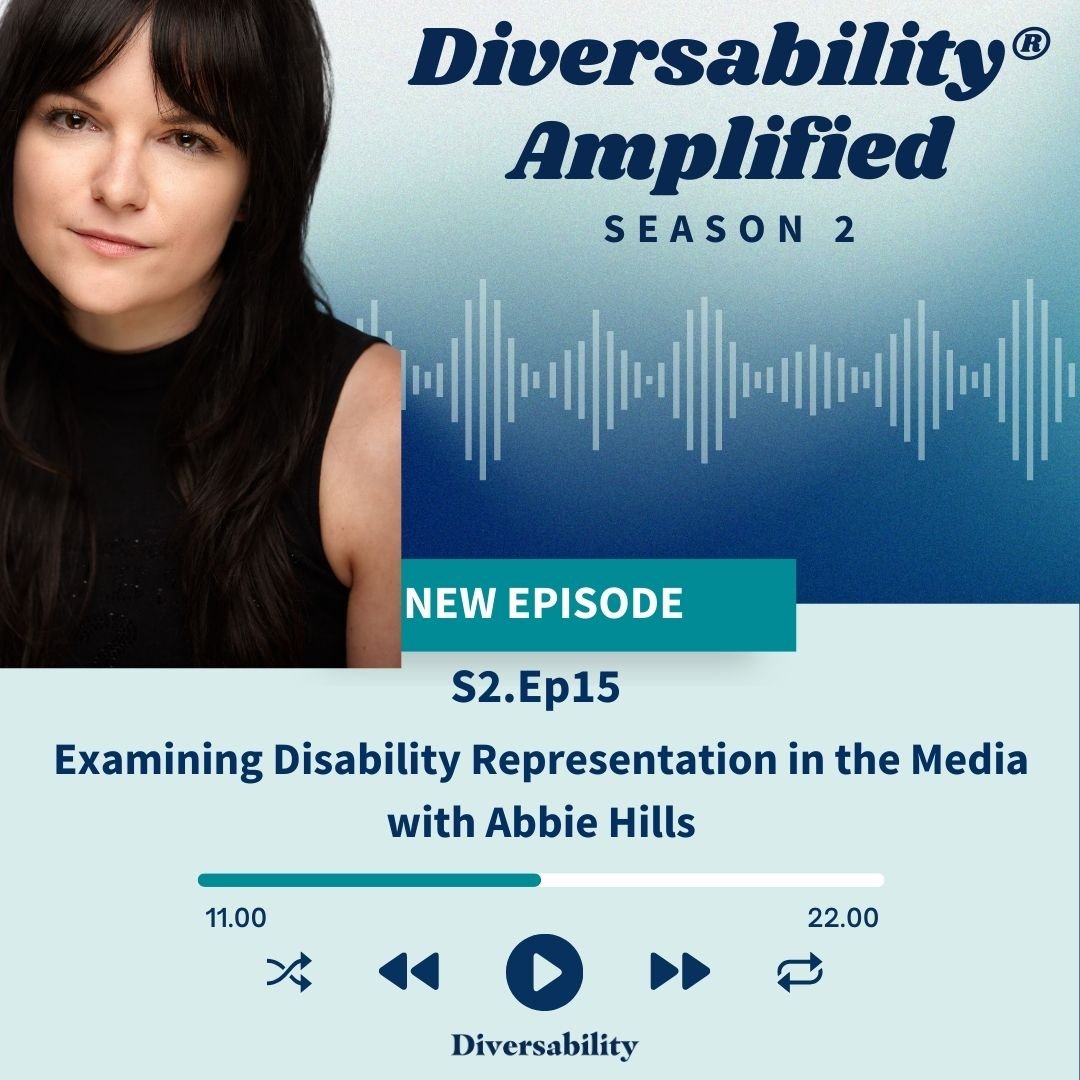
A gradient blue background with airwaves takes up the top half. Dark blue text "Diversability Season 2". To the left is a cutout photo of Abbie. Centered is a blue box with text "New Episode". On the bottom half is a light blue background with audio control mockup. Centered text "S2:E15 Examining Disability Representation in the Media with Abbie Hills."
In today’s episode, host Erin Tatum is joined by Abbie Hills, founder of Dazey Talent and proud representative of a multitude of disabled, D/deaf, and neurodivergent creatives across stage and screen. Erin and Abbie chat about the current state of disability representation in our media landscape, as well as the continued importance for more authentic representation of lived experiences with disabilities. These genuine portrayals are non-negotiable in our ongoing quest to holistically reflect disabled realities in art.
Show Notes
Disability Representation in Media
Quick recap
Abbie and Erin discussed their personal experiences living with cerebral palsy and conducted a test run for the Diversability Amplified Podcast. Abbie, a talent agent with cerebral palsy, shared her insights on disability representation in media and expressed hope for increased inclusivity in the industry.
Disability Representation in Media
Abbie, a talent agent with cerebral palsy, discussed her career path and her commitment to disability representation in media. She highlighted the importance of authentic, inclusive storytelling and criticized the industry's tendency to treat disability as a trend rather than a fundamental aspect of character development. Abbie expressed hope for increased representation of disabled people in senior roles and aspired for access coordinators to eventually become unnecessary as inclusivity becomes ingrained in production culture.
YouTube: https://youtu.be/LBdBSqMqM0A
Spotify: https://spotifycreators-web.app.link/e/LuKbDiIim0b
Transcript
12:42:48 Hello, and welcome to the… flexibility amplified!
12:42:53 My name is Aaron Tatum.
12:42:57 Diversity Leadership Collective, my pronouns. she and her, I'm a white woman.
12:43:04 who's also using a wheelchair, and I. floral sweater, and today I'm here with Abby Hills, who's the.
12:43:13 Hey talent! Abby, how are you?
12:43:16 Hi! Hi, I'm good, thank you. Um, my name's Abby, I'm a white woman with black hair. I'm wearing a red jumper with a bunch of…
12:43:24 like, logos on it, um, and my pronouns are she, her.
12:43:28 Awesome! Well, today we're. We're here to talk about… talk about a very.
12:43:33 that's one of my favorites, which is. Disability representation in the media.
12:43:39 cool, cool, I'm ready.
12:43:42 So, I know, you obviously. have an established career in entertainment, but what initially.
12:43:49 Drew you to the industry?
12:43:52 Hmm… oh, I think I was a bit of a show-off when I was a kid, where everyone tells me that I am, you know, I wanted to be an actor,
12:43:59 Um, you know, when I was a little kid, I was always like,
12:44:01 Putting on shows, making up dance routines, and all that stuff, um…
12:44:05 And once you do that once as a kid, that never leaves you, right?
12:44:09 So, I don't know, I, like, in school, and then college, and then uni, I was just like, film and TV, film and TV, film and TV, that's what I'm doing.
12:44:17 And, like, the lens changed a little bit, it went from acting to doing bits of modeling, to filmmaking, to working in costume.
12:44:25 And then, um…
12:44:27 I just went round and… and…
12:44:30 went into talent management, because I felt like the kind of most organic step, but I think, like, I think…
12:44:35 once you kind of… if you've got the brain that, like, gets switched onto showbiz, and you get excited by it, I think, like,
12:44:41 you'll do anything to make it work. And I think that's what happened to me.
12:44:49 That also speaks so much to the artistic perspective as well.
12:44:54 the people who have an artistic mind. they would just do anything to pursue those endorphins and.
12:45:01 pursue that feeling, because I feel. And it's self-explanatory, but creatives feel the best when they're creating.
12:45:10 Totally, and Erin, honestly, like, if I worked in any other industry… I'm very lucky to work in this industry, but if I ever worked in another industry,
12:45:17 I'd be so bored!
12:45:20 I'd be so bored.
12:45:22 I really, really love it.
12:45:25 You know, that's why self-awareness is important. You're not inflicting your boredom on any other industry because you.
12:45:32 chose to pursue your passion, which is. More than can be said for a lot of other people, so you shouldn't have… Are you proud of yourself.
12:45:40 Thank you.
12:45:44 So, when you started your work as a talent agent.
12:45:50 Just for the audience's background, you're also a woman with cerebral palsy.
12:45:54 So, how did you… how did you sort of approach your work with.
12:45:59 The disability with your own disability informing your professional perspective and the way that you work with clients.
12:46:07 Oh, that's a really good question. Uh, let me think…
12:46:10 So, I think that the first thing that I…
12:46:14 realize is that, like, despite everything I just said, and, like, knowing I wanted to work in entertainment and stuff, like, I had a lot of, um…
12:46:22 stigma around being able to actually do it, because I live with a disability, and I was like, oh, no, I want to hire me, and…
12:46:29 all these horrible things that actually do exist in our community now, I felt at the time.
12:46:34 And I thought, oh, if there's a way that I can…
12:46:36 you know, do it, but work for myself, then that's brilliant, so…
12:46:41 Kind of went and studied management, and…
12:46:43 made myself equipped for it, and then realized that I could set my own hours and all of that stuff. But then it kind of went a lot deeper, and I thought that if I am going to work as a talent manager,
12:46:52 I want to nurture and support voices like mine. I want to nurture and support people from various backgrounds, um, people living with disability as well. Like, I don't…
12:47:03 exclusively represent disabled talent, but it's very much a part of my, um…
12:47:08 like, ethos and a part of what I'm passionate about, having that lived experience.
12:47:12 And I say it in a joking manner, it is no joke, but, like, you can be the best actor in the world, but if you're not an ally,
12:47:19 I'm not signing you. You know, like, if you're not… if you're not an ally to my community and our communities, then I'm… you're not going to be part of my agency, because it really is, like, so, so important to me to have that.
12:47:30 And to have a community that is…
12:47:33 safe, um, empowering, and supportive without
12:47:37 you know, there's enough barriers in the world, you don't want to have to be worrying about the kind of people that you're working with as well, right?
12:47:46 That… that is so true, because. I also feel like within the media landscape, whether it be disability or.
12:47:55 Deafness or heart. Hard of hearing or neurodivergence? Um, difference, especially both.
12:48:03 sending and non-cending differences that create lived experiences are just.
12:48:08 So often thought of as an afterthought in. industry, when really that shouldn't be the case.
12:48:15 largest marginalized group in the world.
12:48:16 Yeah, yeah, and the only marginalized group that you can become part of.
12:48:21 At any time, right?
12:48:24 Yeah, exactly, exactly, so. And I always say everyone should care about.
12:48:33 Yeah, yeah, yeah.
12:48:31 disability because anyone can become disabled. So, it really, it really is the most universal.
12:48:38 Um, and cross-sectional identity, because anyone can join it.
12:48:44 Amen.
12:48:47 Yep, um, and in your work. noticed about the state of disability representation within.
12:48:56 The media ecosystem.
12:49:00 I mean, so I'm gonna speak from the market in the UK. Obviously, like, you know, I keep up with the stuff that's made in the States as well, but speaking from experience in the UK, I think there was a… like, 3 years ago, there was a huge shift and pivot in, like, okay,
12:49:15 access is crucial. We're now supporting disabled talent, and there was, like, a bit of a boom in that.
12:49:20 And then within that, there was sort of, like, a hot minute where having a disability became cool.
12:49:26 And then, you know, all of a sudden, people with disabilities were getting opportunities, but just as quickly as that happened, it stopped happening. You know, we've got all kinds of, um, threats to welfare cuts and things like that happening in our country at the moment, and I think
12:49:39 That is obviously impacting, um, the media as well, right? Because it's a mirror, like, people are making things about what's going on in the world.
12:49:48 And I think there's… there's also kind of been…
12:49:51 I really hate to use the word trends, but it is trends, like, you'll find, um, all of a sudden,
12:50:00 You'll find that all of a sudden, they're starting to make loads of programs that feature autistic characters, or they're making loads of programs that feature wheelchair users, but, like,
12:50:10 the huge disconnect is the fact that it is a trend. Like, there's not just…
12:50:16 it's not just inclusive casting, it's not inclusive storytelling, like, it has to become a trend of something for it to actually happen, and I think that's one of the biggest issues that we're facing.
12:50:29 People need to understand that, um. Disability isn't a box to check on your form or within your.
12:50:39 show or program it's people's. real life, so in yearning for that authenticity of.
12:50:46 Disabled representation, we're… we're really just looking to see the reality we're already living.
12:50:53 reflected back. It does not necessarily, you know, for the token.
12:50:56 For the tokenismortus to look at a program or an entity and be like, well.
12:51:03 They included a disabled. person, so, like, they're not canceled. I feel like the bar has to be higher.
12:51:09 Yeah, 100%, and it's so obvious when they do that, isn't it? It's so obvious when it's a box tick, and the character has no depth, or, like, the… for me, like, the change that needs to happen…
12:51:21 isn't just, like,
12:51:23 like, of course, have disabled characters and write disabled characters into stuff, but write characters…
12:51:29 And then audition disabled actors, and then…
12:51:32 this character happens to have a disability. I think it doesn't always need to be
12:51:38 To do with the narrative, like, we have to live with it every day, so imagine just getting to go to set and just being an actor.
12:51:45 And just having our disability alongside it, rather than, like, having our disability written into the storyline, making it a sad thing, making it this, making it that, like…
12:51:54 What if somebody could just have a character, and then their disability is just part of it?
12:52:00 The last thing I wanna watch is. show where a disabled character's whole storyline is facing ableism, because I do that every.
12:52:09 Yeah!
12:52:10 Every day! Yeah, so you.
12:52:16 Because you want to see a character either experiencing something.
12:52:20 you identify with or experiencing something that you want to live vicariously.
12:52:24 through, but you watch them through the whole spectrum of.
12:52:28 human experience, not just for one facet of their identity.
12:52:31 Exactly, and, like, people consume films and TV shows largely for, like, some kind of escapism, right?
12:52:38 So, why would we watch something that we're then not escaping? Because we're like, oh yeah, thanks for the reminder of what I have to live with every day, that's really cool. Like, it's not enjoyable. And sometimes I feel… I feel bad, because I…
12:52:52 Keeping up with as many, um, disability-led narratives as I should.
12:52:58 Because I just find them super negative, and like, yes, I want to champion the actors and the writers and everything and support it, but…
12:53:05 You know, and it is just kind of gloomy or victim characters, I don't… I don't find that particularly, um, empowering, I don't find it particularly entertaining, to be honest.
12:53:15 So, I think, yeah, like, the writers need to have a bit more of a think and get some…
12:53:21 You know, get some people living with disability writing the characters, because I guarantee that we will be able to write you some really fun characters and storylines. And then, oh yeah, their disability's just in the background.
12:53:32 You know?
12:53:33 Yeah, if I wanted to watch a disabled person suffer, I would look in the mirror. I don't need to turn to media to do that.
12:53:43 I'm sorry that that's so hilarious, but it's… it's so matter-of-fact, and it's so true.
12:53:49 But it's just funny the way you said it, but, like, totally, yeah, yeah, yeah.
12:53:57 marginalized representation is when different. of a character I didn't you?
12:54:05 Yeah, exactly.
12:54:03 aren't relied upon as their storyline. Um, like, there's been a lot.
12:54:10 discourse around plus size with women as well in particular.
12:54:14 particular and sort of moving away from making… making their way, like, the central.
12:54:20 storyline, you can just have. Plus-size characters without mentioning their weight, and I feel like it's a similar thing for.
12:54:29 Yeah, totally. Couldn't agree more.
12:54:28 Um, disability or neurodivergence.
12:54:35 industry has been changing since you got in. I know you spoke a bit about.
12:54:41 The roller coaster of the trends and how disability.
12:54:44 can't be a trend, but how… The industry really evolved, and where do you see it going from here?
12:54:52 Well, I was gonna say I'm really impatient, but I don't think it's just me, I think we're all really impatient, right? Like, it's not…
12:54:58 it's not enough to just be like, oh, we made a blockbuster with a wheelchair user, the industry's off the hook for a little bit, like, it just… it doesn't really work like that, and I think, um…
12:55:08 You know, because I work as a access coordinator as well, right? So I do go onto set, and I support deaf-disabled, neurodivergent talent.
12:55:16 Um, but even with that, like, I've had really busy periods, and then I've had really quiet periods, and then it seems like…
12:55:24 Or where's all the disabled talent, then? On and off camera?
12:55:27 actually, you know, like, we've got to think about the crew and the production side of things as well.
12:55:31 But, you know, more and more, like, people aren't even, especially if they're neurodivergent, like, they're not disclosing, because they're like, oh, I just want an easy day at work, when actually…
12:55:41 is making it harder for themselves, because they have to mask, but there's also this fear of, like,
12:55:46 Not being hard, or not being rehired, or being treated differently, and…
12:55:51 I think… I don't know what the excuse is for things happening so slowly, I don't… like, for me, it doesn't make any sense, but um…
12:56:00 Yeah, I think…
12:56:02 But really, what I just said before, in that, like, the trends and stuff, it's…
12:56:07 It's not… it's not good. It makes me quite uncomfortable, makes a lot of my friends uncomfortable. I mean, it's great when, like…
12:56:12 Somebody who has got that
12:56:14 flavor of the month is being seen for loads of castings, but actually, like, what's that doing when the months that follow, they're getting nothing, because all of a sudden,
12:56:24 insert random disability here, like…
12:56:26 it's not seen as quite unquote cool in the industry at that time. Like, it's really problematic.
12:56:35 theories on this. major, and both as someone who.
12:56:41 Entertainment journalist for 12 years, which is the. Um, disability isn't seen as, like, a vital artery to the cultural heartbeat of the zeitgeist.
12:56:52 Which… which is just, like, a fancy and sophisticated way of.
12:56:56 saying, disability isn't perceived as sexy, and disability isn't.
12:57:01 perceived as cool, which are two qualities that you.
12:57:04 have to have as a community. to be considered, like, a barometer of taste, or a tastemaker, which is silly.
12:57:12 Because community is… As you were saying, are not trends, and aren't meant to go in and out of.
12:57:19 Vogue based on how worthy the mainstream deems them of.
12:57:24 social acceptance, but I feel like. Disabilities, are you so often as a… as a stepping stone or a way to uplift?
12:57:33 Non-disabled viewers to make them. feel better about their own lives and their own flaws and their own.
12:57:39 choices until we have the. privilege of existing with our own emotions and our own autonomy in singularity, it's never gonna change.
12:57:48 Couldn't have said it any better. Yeah, that was amazing, yeah.
12:57:52 So true, and like…
12:57:55 Disabled rage, am I right?
12:58:00 Oh, I know, rain! is, like, to me, the most lustful emotion, because it's one that I'm never justified in feeling.
12:58:11 And so, it's… it's something that. You can look, but never touch.
12:58:14 Mm-hmm.
12:58:15 Because you're never allowed to. be angry as a disabled person and not to be niche, but especially as a disabled person that depends on others.
12:58:24 for caregiving, because you're always supposed to lead with gratitude, and empathy for your.
12:58:30 Caregivers, and paradoxically, you're always supposed to put your caregivers' emotions first, because they're.
12:58:36 They're helping you, but life… doesn't always work like that. And so, disabled range is something that I.
12:58:43 feel intimately in the… I feel as though I can never touch it, but it's… Something that corrts through my veins quite a bit, so it's a paradox to straddle.
12:58:54 Wow, yeah, I can't imagine what that's like, what you said about having to put, kind of, their emotions and feelings before yours. That must be really challenging.
12:59:04 Yeah, and disabled people. I will tell you, especially when it's 24-7.
12:59:09 Because you never get a break and you always.
12:59:12 feel like you're… you're performing every. Every time you have to interact with them.
12:59:18 I can speak for myself and say that I'm always.
12:59:21 interpreting someone else's feelings and anticipating what their next.
12:59:26 move it's gonna be because it's white you have to do to stay stabilize your care on a daily basis, let alone.
12:59:34 Let alone working on everything else and trying. to balance professionalism and career and relationships, so it's a lot of work, and especially, um, with.
12:59:45 my mom dying right now. I feel like there's no.
12:59:49 time for disabled anger? There's a lot of different layers to it as well, certainly, because.
12:59:55 I'm experiencing cerebral palsy, and I have for 30 years, but my mom has been experiencing ALS.
13:00:01 For only the past 8 months, so there's even a difference between terminal and non-terminal.
13:00:08 disabilities, so there's so many different dynamics just happening in my family alone, and it's.
13:00:16 Wow, yeah, that is a lot. And, like, the…
13:00:14 a lot to interpret and navigate every day.
13:00:19 kind of, like, the ultimate level of masking as well, right? When you've got so many different emotions and feelings going on.
13:00:27 Yeah, well, it's interesting because I've always. I've always been the disabled person in my family, and obviously I don't pass.
13:00:34 But with my mom being diagnosed and declining. Declining so quickly, it's like.
13:00:41 Had to take on a new role in the family, because I'm the youngest.
13:00:45 So, in addition to being. Super protected as the disabled one, I'm also protected as the baby.
13:00:51 So, it's been kind of an interesting time to.
13:00:55 just sort of really, really realizing, like, this is the rest of my life and.
13:01:00 My life could… could go on for decades without.
13:01:04 without necessarily having the structure that I've lived with, or that I recognize as being.
13:01:10 Save for a comfortable to move into in the future.
13:01:13 So, as much as I've masked my emotions before, now it's even more so, because everything.
13:01:21 as it should is centering on my mom right now.
13:01:23 But it's just a different mode to be in.
13:01:26 Wow, yeah.
13:01:29 So, I feel like my whole house is like a disability case study.
13:01:38 Um, and speaking of entertainment. in the spotlight, unfortunately, because Eric Dane has it.
13:01:46 He was diagnosed right before my mom, the Grey's Anatomy actor.
13:01:49 Oh, really?
13:01:53 So it's interesting, because they seem to have. similar progressions, too, and that his is also progressing, um.
13:02:00 quite rapidly, which is a shame, because he's a fair bit younger than my mom.
13:02:04 So I was hoping, especially because he has young kids, so I was hoping that it would move.
13:02:10 slower for him, but it's really. terrible, and it really shows the amount of understanding that we need about, um.
13:02:17 terminal and progressive illnesses, especially, but I'm proud. of Eric Jane because he… he still wants to work, and he wants to bring ALS to every.
13:02:28 character he plays, so I think that's really admirable.
13:02:31 Yeah, yeah, definitely. Oh, good for him.
13:02:34 Yeah, but. There are so many disability.
13:02:41 get to be captured, so I yearned for the day where the industry isn't just like.
13:02:48 That's that for the day, like, job done. Like, even within that experience, there are so many nuances and things, so.
13:02:56 I think we need more access coordinators like yourself who.
13:03:00 who can really help performers strive to bring that.
13:03:05 visibility to the best of their ability, no pun intended.
13:03:09 Definitely, yeah. It's, um, it's kind of the same…
13:03:12 Over here, it's like, oh, we've got someone with a mobility aid, good job, team! Like, and that, that's, that's the reality of it at the moment.
13:03:21 And we've had some really good, um…
13:03:24 projects, um, surrounding deaf narratives and deaf characters, and in fact, we had, um,
13:03:30 a whole program, like, where the whole, um, the whole cast and crew, or, like, a huge majority of the cast and crew, um, were deaf, or had experienced deafness, which…
13:03:40 For us, it's a real milestone, but that…
13:03:42 that comes to mind, because it's been…
13:03:46 one thing, you know? It's like the…
13:03:48 the case study, the showcase, um…
13:03:51 It's not the norm at all.
13:03:55 That, that reminds me of. In the States over here, about 15 years ago, we had switched at birth, which was similar.
13:04:03 Where, um… Of the hearing impaired characters were played by hearing impaired actors, and the hearing cast all earned.
13:04:15 ASL, so it was a really. It was a really interesting show, and it's sad to say that that was.
13:04:22 15 years ago, it's like nothing has really… Like, nothing is really… changed or evolved in the landscape, so it feels like all these shows are just kind of considered one-offs, but I wish.
13:04:36 industry could gain more momentum. Going in terms of the authenticity of representation.
13:04:41 Me too, me too.
13:04:45 Um, those were all of. questions that I had, but I like to give our guests a little.
13:04:51 a little bit of the floor to kind of.
13:04:53 Just do, like, an open conversation or. bring up anything! How do you feel as though.
13:05:00 Your work will sort of change in the. few years, and how do you envision.
13:05:05 Um, what we perceive of. as authentic portrayals really changing or sort of finally making it to screen.
13:05:15 Um… wow.
13:05:17 I…
13:05:19 So, I'm trying to think of this, because, you know, I do so many things, right? I'm an agent, access coordinator, I'm writing my own projects as well, which I'm trying to push and pursue, so different…
13:05:29 Yes, the different lanes of that, so I guess…
13:05:27 Oh, yeah!
13:05:30 Uh, next few years, my writing, which is, um…
13:05:34 They're never, again, never disability-focused, but they are… they have disabled characters, right? Obviously. Um, I want to get them made.
13:05:43 Of course.
13:05:42 Um, as a talent agent, I want to be seeing more, um, breakdowns and castings on a daily basis that are truly inclusive, not just, like, cherry-picking, um,
13:05:55 bits, you know? Like, being actually inclusive castings. Um…
13:05:59 I'm being open, and being able to really propel my clients to do what they want to do without feeling like there's just endless struggle.
13:06:06 Um, and then as an access coordinator,
13:06:09 the ideal situation is…
13:06:12 I work on so many projects, like, super, super busy, and all my other access coordinator friends, they're super, super busy, because everybody needs an access coordinator, because…
13:06:22 there's… well, there's demand… there's demand anyway, right? Let's be clear on that, but…
13:06:26 people are realizing they need access coordinators, um…
13:06:31 In the States, too. I'd love to come and come do some access work in the States, that'd be really, really cool.
13:06:35 Um, but then eventually, like, late future,
13:06:39 I don't work as an access coordinator anymore, and that might sound strange, but…
13:06:43 Because in an ideal situation, then,
13:06:46 The inclusive culture will be so embedded in the production,
13:06:49 that you won't need a specialist to do it, your teams will just be so aware, and they'll be so…
13:06:54 ready to support disabled people, cast, crew,
13:06:58 Anyone catering, like, I don't know, facilities, like, whoever's working on the show, like, it's so embedded.
13:07:06 And everybody is so aware, and it's such a normal part of the production, that…
13:07:11 Actually, access coordinators aren't needed as much. So…
13:07:14 Yeah, I mean, that's… that's kind of the headline, short term.
13:07:18 workloads and what I care about, and get the people doing what they love, um, and then, yeah.
13:07:24 That's where I'm at, I think.
13:07:26 Yeah, it's… it's funny that. No worries! We're in a place where you would.
13:07:32 I hope that your primary job is eventually phased out as a part of.
13:07:36 progress.
13:07:36 Yeah, I know, I know, it's wild to say, like, even when it comes out my mouth, I'm like, oh, it's a weird thing to say, but I said it because I believe it, and I think…
13:07:45 you know, with an attitude switch, that could be the… that could be the moment. I mean, I think you should always have somebody with eyes on access, but I think the emphasis of the role would change significantly, because…
13:07:57 It would just be embedded in the culture of what's being made.
13:08:04 such an aspirational future where. You don't need a specific person to, like, make.
13:08:10 Make sure that actors or crew with disability are ha-.
13:08:15 having an okay time on set and it's just.
13:08:17 Naturally anticipated and handled within the course of. the daily activity of the workday.
13:08:24 Mm-hmm. For sure.
13:08:29 What do you think, when you envision 10 or 5th.
13:08:33 Teen years from now, how do you. Hope that that industry might change.
13:08:39 Well, I mean, everything we've spoken about, for a start, I think, yeah, I think that's the thing. Um…
13:08:45 I would love to see more disabled people in senior roles.
13:08:52 Like disabled showrunners, disabled exec producers, like, more disabled Oscar winners, like, like, big, like, you know…
13:09:00 off-screen as well as on-screen, but decision-making…
13:09:03 highly creative, influential roles. I think that will be the time that…
13:09:09 real change starts to happen.
13:09:14 That's… that's a time that we… that we can all wish for, and I know.
13:09:21 the US and the UK experiencing really harmful. harmful and scary infringements on disability rights, sort of.
13:09:30 the media can be. be an escape and a balm for that, which is to remind our community that we're.
13:09:37 We're still here, we're still showing up, and we're still important.
13:09:42 Yeah, absolutely. That seems like such a beautiful point to end on.
13:09:47 Of course, thank you so much, Abby! This has been such.
13:09:52 A lo- a lovely com… conversation, and we look forward to having you back!
13:09:57 Oh, thank you, Erin, it's been a lot of fun.