
Making Menstrual Health Education Accessible Across Disabilities
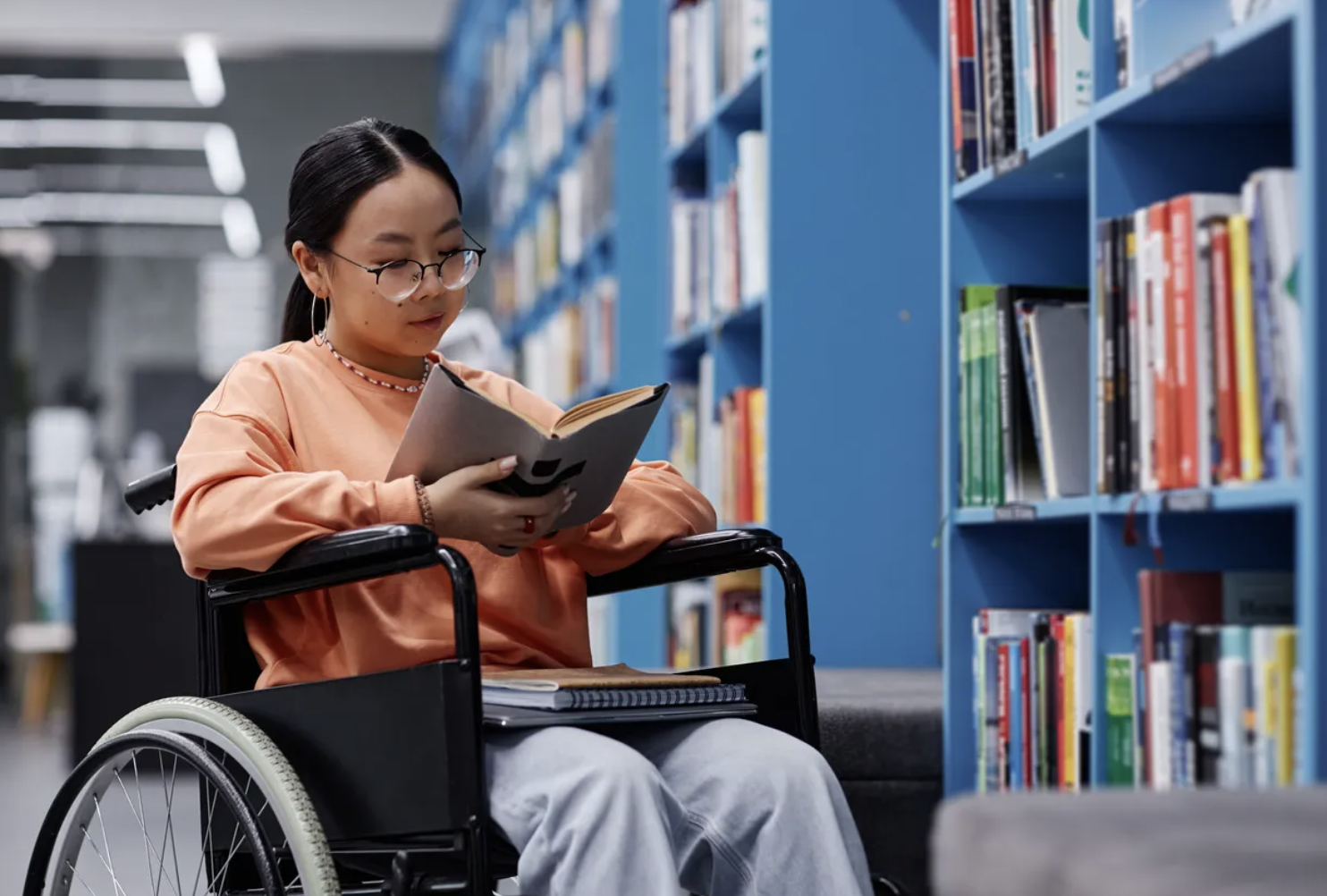
Student in wheelchair reading in library.
By Arielle Dance, PhD
This piece was originally published by Our Bodies Ourselves November 2026.
Across disability types, we need inclusive menstrual education. Many disabilities require tailored education about menstruation, hygiene, product choices, and tracking menstruation. Unfortunately, standard sexual health education does not include menstrual health education for disabilities, often leaving it up to parents, aids, and caregivers to fill that gap.
Every disabled person deserves care adapted to their individual needs. It is imperative to acknowledge that some disabled people experience difficulties that can increase anxiety, emotional dysregulation, and social isolation because their needs differ. For example, there are reasons why disabled people may change their period products less often. They may have sensory sensitivities or be unaware of when products need changing. They may not have access to public restrooms they can use.
There is a true need for additional research, specified resources, and tailored education so that we can support disabled menstruators and ensure we all have the proper preparation for managing our menstruation. Periods are stressful enough without having to navigate the additional barriers of ableism.
What Disabled Menstruators Experience and Need
Physical Disability
Menstruators with physical disabilities face particular challenges. For example, those of us who sit in wheelchairs for long periods of time may experience accidents and leaks when our menstrual pads shift or soak. Unfortunately, if we can’t access a restroom in time, we are also at a higher risk for leaks or accidents. For some disabilities that impact mobility, balance, or energy, the act of changing products can range from uncomfortable to exhausting. Menstruators who use urinary catheters may also experience discomfort with menstrual products. Those of us with fine motor challenges may findmenstrual products and their packaging difficult to use.
Blind and Low-vision & Periods
For those of us who are low vision or blind/visually impaired, menstruation can present tremendous difficulties. We may not recognize when a period begins or ends or detect when period products need to be changed. We may be unable to select products by absorption Internal menstruation products are not a practical option for many of us because we cannot access information on how these products work.
We might rely on non-disabled caregivers and family members for support, as other disabled menstruators do. We might rely on ourown senses of smell and touch. In some cases, we may choose to wear products for extended periods of time just in case our period begins or if we are unsure if it’s finished.
Autism & Neurodiversity
Due to our amplified sensory sensitivities, those of us with autism can find the experience of menstruation uncomfortable and overwhelming. Someone with hypersensitivities may feel discomfort with menstrual products and clothing. Menstruation can also heighten emotional dysregulation and behavioral difficulties for those of us who have autism. Struggling with the various phases of the menstrual cycle and the subsequent changes in their bodies, may add distress, increased anxiety, or meltdowns due to changes in hormones. Basic menstrual care, specifically related to hygiene and to using menstrual products, can be difficult for some neurodivergent menstruators. There is evidence that people with autism are at an increased risk for irregular periods and PCOS.
Recommendations for Bridging the Gap
Using Technology
Technological advances can help us overcome the barriers to inclusive, accessible menstrual health education. The use of assistive technology can support usin selecting menstrual products, tracking periods, and providing guidance on product use. Period tracking apps can help us track our menstrual symptoms throughout the month and provide general date ranges for when to expect periods.
Apps like Be My Eyes and The RoomMate can help visually impaired menstruators review product labels and find the best menstrual products on shelves in the store.
Finding the Best Products
Some disabled menstruators prefer to purchase their products online with the help of a trusted loved one rather than navigating brick-and-mortar stores. However, many of these products are not designed for disabled people. Challenges from sensory issues to limited mobility can make the products impractical for those of us with disabilities. For example, if we struggle with grasping immobility, it can be difficult to open packaging.
Menstrual cups and period underwear come with longer wear time, making them a good option if we struggle with knowing when to change products. The Keela Flex menstrual cup was designed for ease of removal for people with disabilities. Adaptive devices like the Tina tampon insertion applicator and The Pixie cup insertion applicator help support people with and without disabilities.
It is important to recognize that these products and approaches often mean it costs more to manage menstruation when we have disabilities. Some disabled people already struggle to pay for other necessary medical expenses, medications, and support expenses.
Improving Accessibility
The disabled community has an ongoing need for accessible public restrooms. Although most public spaces aim to have accommodating restrooms, these facilities still fail to need all the needs of disabled people. A comfortable, clean, and accessible restroom is imperative for disabled menstruators. To accommodate those with mobility devices, having larger stalls with sinks in the stall can be especially helpful. Having the sink in the stall is a great aid for cleaning up messes or accidents. Those of us who are blind or low vision can find it difficult to locate the waste bins in the stalls. Having brightly colored bins instead of ones that match the walls would be a welcomed improvement.
Need for Education and Research
In order to improve the ways that disabled people can manage menstrual health, we need to tailor research and menstrual education to various disabilities. Even when it is available, menstrual health education is rarely developed with disabled people in mind. We need to know how to manage our menstrual health before our first period. This means having access to resources that address the individual needs of various disability types.
We need educators who use sign language, packaging with braille instructions, audio-support in stores, and training to equip caregivers. Educators should consider methods using non-visual senses and audio-tactile tools in order to make their knowledge accessible to blind or low vision menstruators. Such hands-on methods can provide clear expectations and demonstrations.
Across disability types, some resources recommend exploring the possible need for menstrual suppression in order to discontinue periods. Menstrual suppression involves the use of hormonal medications (such as Depo-Provera injections) to stop periods. It may not be the best decision for everyone. We should discuss this medical choice in detail with our healthcare providers.
Generally, disabled menstruators should be informed of current offerings of products, assistive technology, and understanding the changes in their bodies. Such conversations lead to an inclusive approach to menstrual health management. These tailored approaches to understanding and managing menstruation will give us knowledge, independence, skills, and autonomy over our bodies.
Alongside improved research and education, true menstrual equity means we have public restrooms, menstrual products, and menstruation tracking apps that are available and accessible across disability types.
Sources:
Clue. Disabled people have periods, too. 2022.
Monthly Dignity. Beyond Vision: Managing Menstruation as a Blind or Low-Vision Person. 2025.
Monthly Dignity. Managing menstruation with a physical disability. 2024.
Dr. Charis Chambers, The Period Doctor. Instagram video post. 2026.